Monday, September 17, 2012

What's Blooming in September? Plumeria

Isn't this gorgeous?  I understand the common name is Frangipani, but I have always known it as the botanical name, Plumeria. The flowers can be white, yellow, pink, or dark rose.

These tropical plants look like a thick stick when you plant it.  It is definitely a tropical plant, but it really does well in our area.  They don't need much water.  In fact, over-watering can make the root system rot fairly easily.  I should use fertilizer more often.  I keep my Plumeria in pots in an area that is watered with the sprinkler system.  

In the winter, the leaves fall off and it looks like the stick I started with.  In the spring, the stick will grow a new branch so a mature plant will look like a tree with many branches.

They can be put in the ground, but they cannot tolerate temperatures below freezing.  My friend Kristen has a lot of mature plants grown in the ground.  She goes out each winter and puts a styrofoam cup stuffed with cotton on each and every branch tip.  I think she also wraps the plants.  I used to keep a plant in the ground and I would toss a sheet over the plant.  It must not have been enough because the plant died.  I'm not as dedicated to caring for any plant, not even these beauties.  Kristen gives her plants tender loving care and they are so big she has to cut them back in the spring.  She gave me some of the "sticks" and now I have my plants in pots.  

If you have such a generous and kind friend, the stick needs to be given a chance to dry out a little and heal over at the base.  These new cuttings are most likely to rot

In the winter I tote the pots into the garage. They do not need any care whatsoever during their stay in the garage.  Do not water!  When the leaves start growing again in the spring, haul the pots back out and start watering lightly.

Procrastination

 I have been walking past the overgrown Agapanthus for quite a while.  The plant has grown away from the original center plant leaving huge thick roots around a bare middle.

These roots looked like concrete.  I have been putting it off.  I didn't think I wanted to rent a jack hammer or swing a sledge.  Ugh!

So I've been thinking maybe I could start at one side and over time, work my way through this eyesore.


So I grabbed my work gloves, my heavy duty work sandals, and the shovel.


It turned out most those concrete "logs" were actually just a thin covering over rotted centers.   I was able to pull out a lot of these with my hands.


Sure, some of the root stalks were still viable, but all of the plants in this area had the long overgrown look.  Out they go!


I was able to pull all of the Agapanthus in just a few hours.  Whoopie!

I replaced the old plants with some that had planted themselves in the wrong place...  in other words, they had become weeds.

I covered the area with home-grown mulch.   Much better!

I won't wait so long to thin the Agapanthus.  It was work, but not nearly as bad as I thought.

Sunday, September 16, 2012

Cut Us Back, Please!!!

The Hydrangeas have been begging me to cut them back!  I really don't mind the look of the spent flowers.  They keep a pale version of their color.  I've even cut them and kept them in vases inside like that.  But the plants will really do better if I cut them back. 

You can just barely see the dried flower at the top of this picture.  Below that you can see the back of a large leaf covering the stem. Then below that you might be able to see some n3ew buds right at the base of the two leaves.


 I think you can see the new buds better in this photo.  If I cut just above these buds, they should both branch out.  As I wrote in my last post, this will make the whole plant healthier and more full.  The plant won't spend any more energy trying to maintain the old dying portion and can spend its energy on the new growth.


So I cut it back right above the leaf nodes.  Any lower and I might damage the new buds.  Any higher and I'd leave a branch to rot.  This should be just right to dry up and heal over.


Sunday, September 9, 2012

Cutting Back

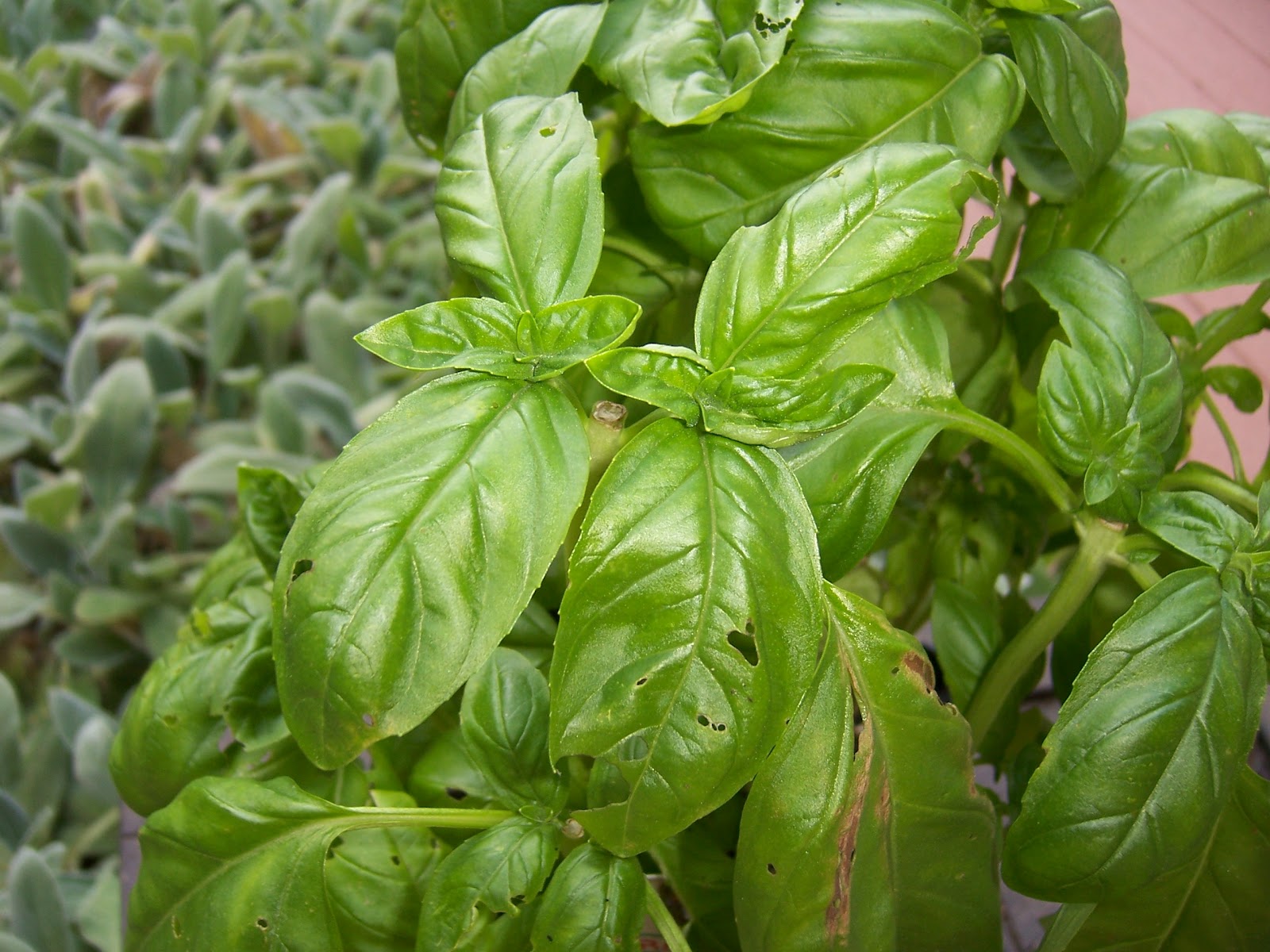
I remember when my dad would cut back our huge Chinese Elm tree in our front yard.  It would look so bare and dead.  But of course, it always grew back again, healthier than ever.  It's actually good for most plants to be cut back.  I recently bought a little Basil plant from the grocery store.  I have not gotten around to planting it in the ground yet, and I may decide not to.  It's doing fine where it is and I really see it as a temporary visitor to my garden.

But like most herbs, it needs to be cut back.  This is really a win/win situation!  As I cut a few bunches of basil, it encourages the plant to grow back stronger.
In the middle of this photo, you may be able to see a place where there are two sets of new growth with small leaves.  Look closely between them and you may see a whitish place where I have pinched off the branch.  I made a great salad with garbanzo beans and fresh tomatoes and I also added some fresh basil.  That was a couple of weeks ago.  It's fairly typical for two branches to start where ever one is snipped, so the plant grows back fuller. 

You can just pinch back the ends of the new growth, like those 2 sets of tiny leaves above.  Or you can clip lower on the branch.  But whenever you cut back, try to cut just above where there leaves growing.  You don't want to cut very far between branches or leaves.  A short section of branch will just heal over.  More than that leaves the plant vulnerable to disease and insect damage.  Not only that, it won't look nice having all those sticks poking out.

I think I'll go out right now and pinch back that basil some more.  Shall I make pasta with chicken and marinara with fresh basil for dinner tonight?


Saturday, August 18, 2012

A Hidden Gem

I was cruising through the City's website and found this hidden gem.  Water-wise Gardening in Camarillo.  You've got to check it out!

Friday, August 17, 2012

Time for Power!

It's been over 6 weeks since my last entry!  Bloggers should post regularly and gardeners should tend to their gardens regularly and I haven't done either.  I went to the Stampin' Up! convention in Salt Lake City.  The grand-kids came for a few days and then we took them for a vacation in Indio. (HOT!!!)  Then it's really been too hot here to want to work outdoors.  I bought the new My Digital Studio 2+ and have been working on that.  I love it! 

But my garden has been calling me too.  So today it was time to get the biggest bang for my buck.  No time for plucking weeds today!  I got out the power tools. 

The biggest eyesore today was our xeriscape area on the other side of the driveway.  This patch gets almost no water, so I've put in plants that thrive with neglect.  It's predominately Statice and Sage with a few Aloes tucked in the middle.   The sage grows very quickly and can get "leggy."  If you regularly trim it back, it stays nice and bushy, but I don't seem to get around to it very often.  If you cut it back all the way, it looks naked, with just a few sticks poking out with few or no leaves.  I learned a trick from watching the gardeners which I've put to use now that I'm the gardener.

The trick is to cut the bottom and sides of the sage and then let that grow back a bit and then cut off the top.  That leaves part of the plant looking OK all the time.  So I brought out the Hedge Hog to cut back the sage. While I was at it, I cut off a few of the dried flowers from the Statice.  I should really be clipping the dead parts off.  I did that to one plant, but I didn't have time to do it right for all of them.  So I tidied them all up a bit.  I raked up the big stuff. then I got out the Leaf Hog to vacuum up some leaves and lots of dried Statice flowers.  Time to call it a day!

Perhaps tomorrow I'll get back to the daily weeding and deadheading.

Tuesday, July 3, 2012

Theological Weeding

Thanks to my friend Judy, I am now passing my time weeding contemplating theological issues.  When last I wrote about weeding, I was not thinking Godly things at all.  But my sister Irene responded and I've changed my thinking.

I was blaming the weeds, calling them sneaky and a wolf in sheep's clothing.  But as I was weeding just a few feet away from those weeds, I found a new enemy.  This one too, was masquerading as the desired plants.  I was weeding out the clover from the ornamental strawberries.  The soil, light, and watering conditions are not much different, but a different weed had taken over.  But it wasn't the weed's fault.  It was the way I had reacted to the weeds.

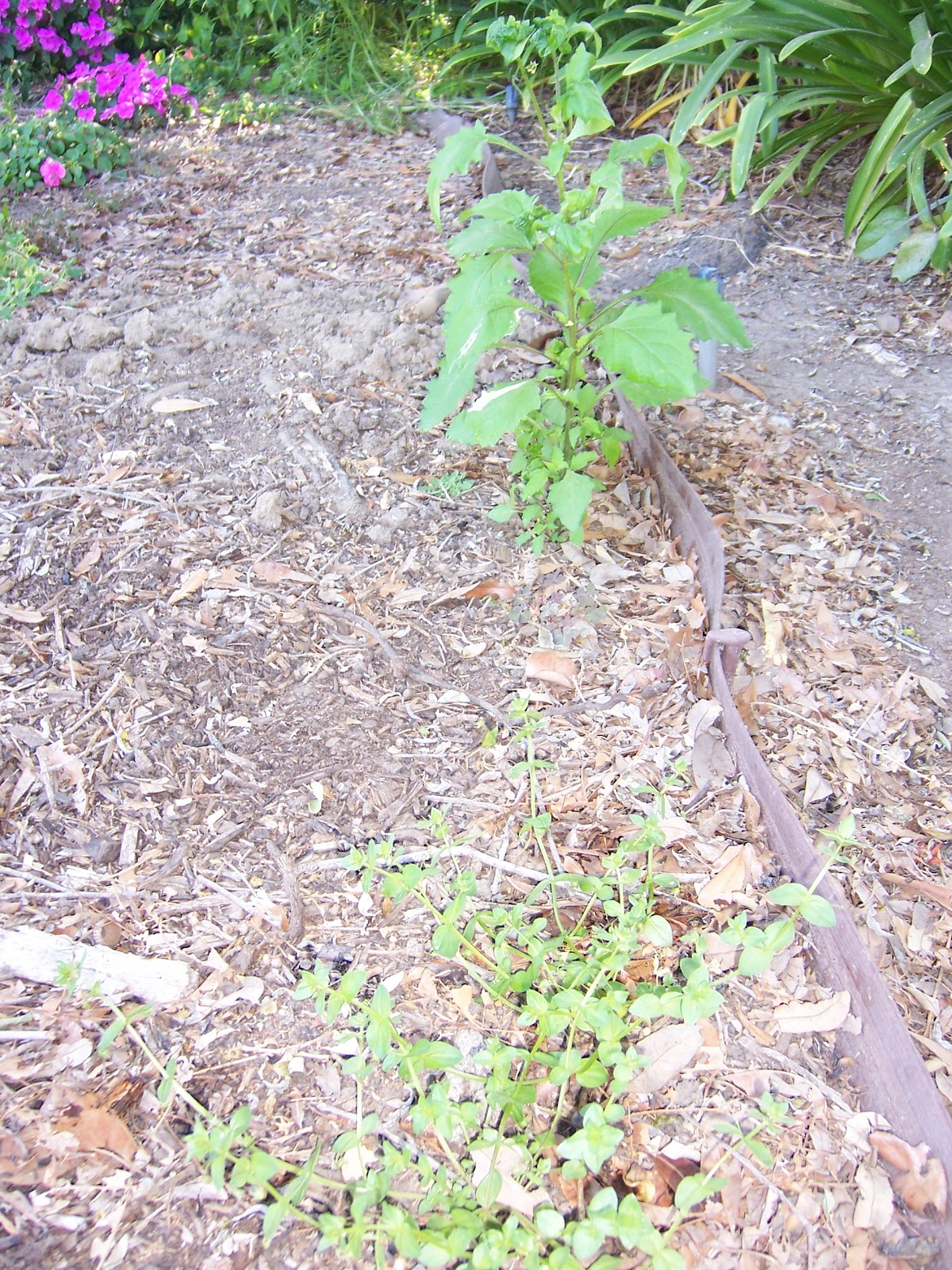
Let's go back to my definition of a weed: a weed is an undesirable plant.  It's a plant that has planting itself where you don't want it. The weeds to the left are easy to spot.  Nothing else is growing there.  I didn't plant them.  They are not a plant I want.  They are weeds.


But the ornamental strawberries that have sent runners into the area where I've planted pansies are also weeds.  I like the ornamental strawberries but they have planted themselves where I don't want them.  They are also weeds.


There are people who actually like dandelions.  For all I know, there are people who intentionally plant dandelions.  There are definitely people who harvest dandelions for their salads or to make dandelion wine.  Most of us would agree that we do not want dandelions growing in our gardens.  There are dandelion weeders and most herbicides list dandelions as something it will kill.  If you have dandelions in your lawn, there are fertilizers that you can add to promote your healthy grass while killing the dandelions.* (See the bottom of this blog entry for an explanation.)  So most of us know what dandelions look like.  As soon as we see those bright yellow blossoms, we make plans to get rid of the plant.  We may tolerate a child blowing the dandelion puffs, but we also cringe at the thought of each one of those seeds growing into a weed we will have to pull out.  Dandelions are an easy weed to spot and there are plenty of ways to get rid of them.

But as I've said earlier, we don't have a lawn in our garden.  We have used other ground covers that do not provoke our allergies.   So that means weeding.  Our ground covers do not look like dandelions.  I can still spot these weeds and take care of them fairly easily.  But near our door we have elfin thyme.  It has tiny round leaves and the plants hug the ground and spread outward.  So when the weed with tiny round leaves and the plants hug the ground and spread outward started growing, I don't notice right away.


And where the ornamental strawberries with their three smallish leaves on a plant that spreads with runners are growing,  I didn't notice so much when the clover with their three smallish leaves on a plant that spreads with runners started in.  It was harder to spot.


Ready for the theology?  There is sin that's easy to spot.  There are some activities that most of us notice right away and we know to keep our distance.  If we are drawn to it, we pretty much know that we are violating the standard moral or ethical code.  But there is sin that's not so easy to spot.  Maybe it's a good activity, but done at the wrong time, the wrong place, or just too often.  Or maybe it's an activity that is OK for some people, but not for us.  We can easily do this type of activity and it's fine at first.  But slowly, without our noticing, it becomes sin.  It takes over our lives.  And then it's hard to stop.

When the clover started growing, I saw some of it.  But I'd heard clover actually adds nutrients to the soil.  And the red-leafed clover is very hard to notice with its dark leaves on the dark soil.  I consciously allowed the clover to grow, hoping the strawberries would be able to hold their ground.  And after all, the runners get so tangled with the runners from the strawberries.  I think I will get around to weeding later.  Just like those little sins we don't worry too much about, they got out of hand and I'm having to work a lot to make the change now.

Are you still with me?  Now I have a gift for you, if you want it.  I was weeding around the pansies and found this lavender "weed."  I planted lavender, but not there.  This little guy planted itself in the wrong place.  I put it in a pot and I'm fairly sure it will make the transition to container living, at least for a while.  If you want it, and it's still alive, you can have it just for the asking.  First come, first served.  (Assuming we can make arrangements for the transfer that works out.) Just leave a comment, and say you would like to give this lavender plant a home.


* Dandelions are dicots and grass is a monocot.  These herbicides kill the dicots.  That works just fine when trying to kill weeds in your lawn.  If you use these products to kill dandelions or other weeds among your shrubs and flowers which are also dicots, you will kill your desired plants. And yes, there are actually herbicides that kill grass that grows in among your flowers.