Tuesday, July 3, 2012

Theological Weeding

Thanks to my friend Judy, I am now passing my time weeding contemplating theological issues.  When last I wrote about weeding, I was not thinking Godly things at all.  But my sister Irene responded and I've changed my thinking.

I was blaming the weeds, calling them sneaky and a wolf in sheep's clothing.  But as I was weeding just a few feet away from those weeds, I found a new enemy.  This one too, was masquerading as the desired plants.  I was weeding out the clover from the ornamental strawberries.  The soil, light, and watering conditions are not much different, but a different weed had taken over.  But it wasn't the weed's fault.  It was the way I had reacted to the weeds.
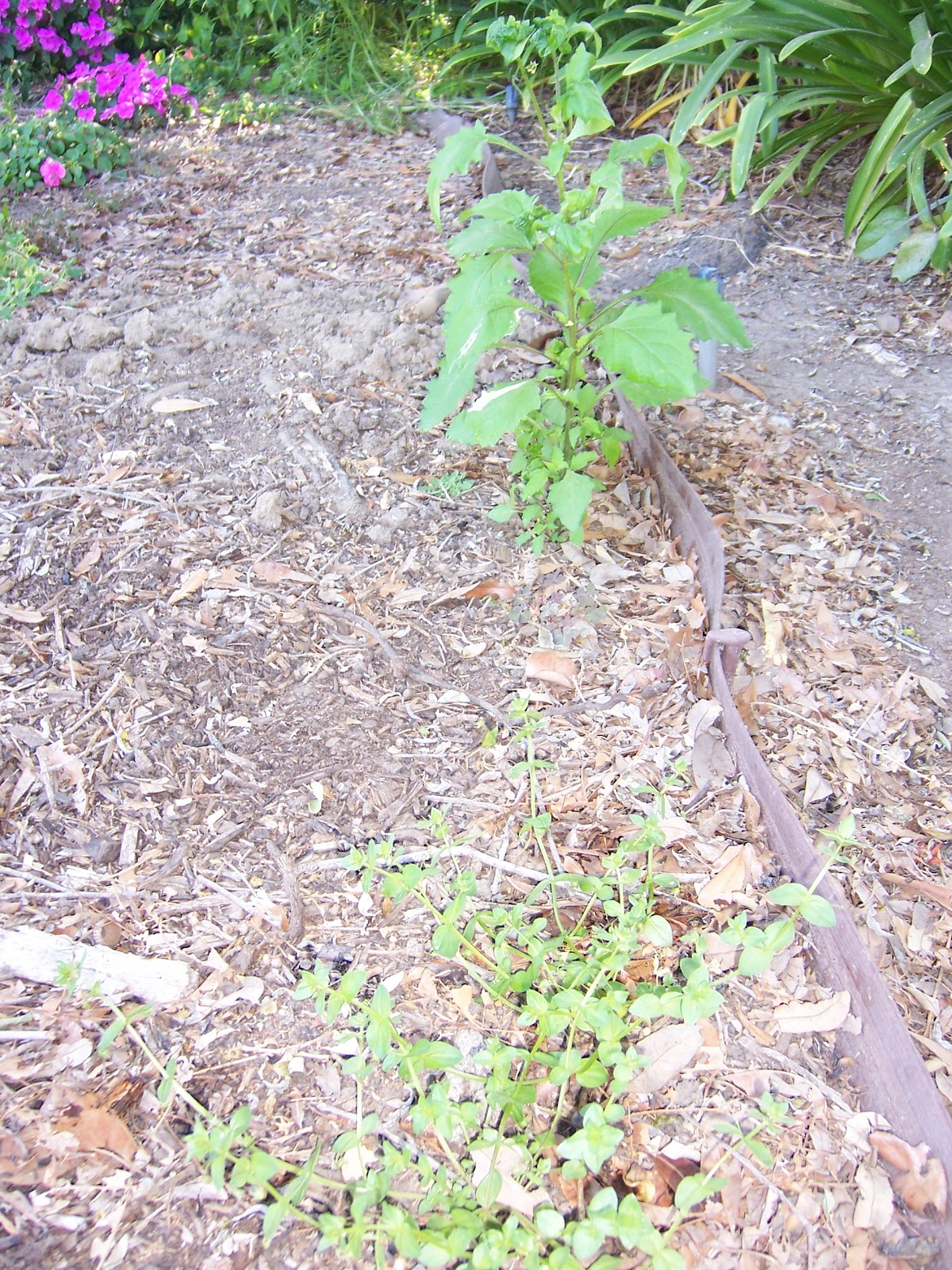
Let's go back to my definition of a weed: a weed is an undesirable plant.  It's a plant that has planting itself where you don't want it. The weeds to the left are easy to spot.  Nothing else is growing there.  I didn't plant them.  They are not a plant I want.  They are weeds.


But the ornamental strawberries that have sent runners into the area where I've planted pansies are also weeds.  I like the ornamental strawberries but they have planted themselves where I don't want them.  They are also weeds.


There are people who actually like dandelions.  For all I know, there are people who intentionally plant dandelions.  There are definitely people who harvest dandelions for their salads or to make dandelion wine.  Most of us would agree that we do not want dandelions growing in our gardens.  There are dandelion weeders and most herbicides list dandelions as something it will kill.  If you have dandelions in your lawn, there are fertilizers that you can add to promote your healthy grass while killing the dandelions.* (See the bottom of this blog entry for an explanation.)  So most of us know what dandelions look like.  As soon as we see those bright yellow blossoms, we make plans to get rid of the plant.  We may tolerate a child blowing the dandelion puffs, but we also cringe at the thought of each one of those seeds growing into a weed we will have to pull out.  Dandelions are an easy weed to spot and there are plenty of ways to get rid of them.

But as I've said earlier, we don't have a lawn in our garden.  We have used other ground covers that do not provoke our allergies.   So that means weeding.  Our ground covers do not look like dandelions.  I can still spot these weeds and take care of them fairly easily.  But near our door we have elfin thyme.  It has tiny round leaves and the plants hug the ground and spread outward.  So when the weed with tiny round leaves and the plants hug the ground and spread outward started growing, I don't notice right away.


And where the ornamental strawberries with their three smallish leaves on a plant that spreads with runners are growing,  I didn't notice so much when the clover with their three smallish leaves on a plant that spreads with runners started in.  It was harder to spot.


Ready for the theology?  There is sin that's easy to spot.  There are some activities that most of us notice right away and we know to keep our distance.  If we are drawn to it, we pretty much know that we are violating the standard moral or ethical code.  But there is sin that's not so easy to spot.  Maybe it's a good activity, but done at the wrong time, the wrong place, or just too often.  Or maybe it's an activity that is OK for some people, but not for us.  We can easily do this type of activity and it's fine at first.  But slowly, without our noticing, it becomes sin.  It takes over our lives.  And then it's hard to stop.

When the clover started growing, I saw some of it.  But I'd heard clover actually adds nutrients to the soil.  And the red-leafed clover is very hard to notice with its dark leaves on the dark soil.  I consciously allowed the clover to grow, hoping the strawberries would be able to hold their ground.  And after all, the runners get so tangled with the runners from the strawberries.  I think I will get around to weeding later.  Just like those little sins we don't worry too much about, they got out of hand and I'm having to work a lot to make the change now.

Are you still with me?  Now I have a gift for you, if you want it.  I was weeding around the pansies and found this lavender "weed."  I planted lavender, but not there.  This little guy planted itself in the wrong place.  I put it in a pot and I'm fairly sure it will make the transition to container living, at least for a while.  If you want it, and it's still alive, you can have it just for the asking.  First come, first served.  (Assuming we can make arrangements for the transfer that works out.) Just leave a comment, and say you would like to give this lavender plant a home.


* Dandelions are dicots and grass is a monocot.  These herbicides kill the dicots.  That works just fine when trying to kill weeds in your lawn.  If you use these products to kill dandelions or other weeds among your shrubs and flowers which are also dicots, you will kill your desired plants. And yes, there are actually herbicides that kill grass that grows in among your flowers. 


Tuesday, June 26, 2012

The Wild Things

OK.  They are not plants.  But these finches are an important part of my garden.  I love watching them share the choice perches.  I love the songs they sing most of the day.  I love the colors of the red-chested house finches and especially the bright yellow and black goldfinches.  The birds and the pond are as important to my garden as any plant.

We used to feed the standard bird seed, but I've switched and exclusively buy the more expensive Nyjer, or thistle seed.  This is the seed the finches prefer.  I've found it everywhere the other bird seed is sold.  It's been treated so it doesn't sprout weeds under the feeder.  I do try to vacuum up the spent seeds every now and then, mainly for cleanliness.  I use the Leaf Hog to vacuum. 

We can go through about a bag a week, especially in the summer.  I have thought about buying a huge 50 pound bag, but then I'd have to find a place to store it.  So I buy one or two of the biggest bag I can find when I'm at Target, Walmart, or Home Depot.  The Walmart site said prices depend on location, so it may be different where you are.
Walmart:  $15.87 for 7 lbs
Home Depot $15.98 for 7 lbs


The feeders we use are similar to this one from Target.  Again, it's not cheap.  I love feeding the birds, but I do not like feeding the squirrels and rats.  We've tried a lot of different ways to keep these rodents away. 
  • I thought having the feeders hanging from these tall "shepherd's crook" hangers would be enough, but the rodents can just run up the skinny poles as if they were ladders.  
  • We've tried dried pepper flakes.  The theory is that the rodents' don't like the taste and the birds don't mind it.  
  • We've tried a thistle "sock."   We had the plain kind and the fancy kind with a dome cover.  These didn't keep the rodents out.  The birds loved them!  We would have maybe 30 birds on the sock almost all day.  There were so many that it felt like a swarm or infestation.  We also went through a lot of bird seed!
  • This style of bird feeder has springs inside.  When the heavier rodents land on the feeder, the outside falls down, closing off the holes.  When the feeder is full, 8 birds can feed at once.  There is often a bird waiting its turn on the top of the crook and more waiting in the bushes and the tree nearby.  We have 2 feeders in the back yard, so there are plenty of birds to watch.
We rarely have the squirrels empty out our feeder any more.  Occasionally a family of rats will move in.  When they get to be a problem I put a trap next to the fence by the feeder.  I surround the trap with an exercise pen to keep the dog from getting his nose or paw caught in the trap.

I just moved one feeder closer to our bedroom window.  I was afraid it would not work out there.  I was afraid it was too close.  I thought the birds would be too wary of our movements inside.  They often, but not always, fly away when we're moving around.  If we sit still, they don't seem to mind us too much, though they do seem to keep an eye on us.  I was also worried they would run into the glass.  That hasn't been a problem yet.  One of the first things I do in the morning is open the shades so I can watch the birds for a while. I love having the feeder closer to the window so I can get a close view.

I think the location of the feeder is important.  When I gave up on the thistle socks, I gave them to a friend and she never saw any birds on it.  I think she said she had it by her front sidewalk.  Perhaps there was too much traffic there.  I think she also has cats, so that might be the problem as well.  I think the birds appreciate a tree where they can fly to escape or rest.  But there may be other reasons why we can attract so many birds here.  Even before we had the feeders I would seem them in our trees and splashing in the waterfall.  We may also be in the flight path where other people feed birds.  When you first put a bird feeder out, be patient.  Try one location for at least a week or two.  If they don't use the feeder by that time, try moving it.

This site sells a different kind of feeder.  I might give their roller feeder a try!   They recommend sunflower kernals.  I don't know if their feeder would work with the tiny Nyjer seeds.  The site does offer some great  feeding tips and links.


Wednesday, June 13, 2012

Let the water flow!

We had a leak. . .  not a major leak and it turned out not to be much of a problem to repair.  But to locate the leak we had to turn off the waterfall.  And since the leak was in the skimmer we needed to keep the waterfall and pump turned off until we could get it fixed.

Oh, how I missed the sound of the waterfall!  It brings life to our whole home!  The sound lulls me to sleep at night.  The sight of the waterfall greets me in the morning as I get my coffee.  Even now, as I sit at my desk, I can hear it flowing. It is truly the highlight of our garden.

Due to a series of technical issues, we had trouble touching base with Frank Cornellier.  I worried that we would have to find someone else to call on for maintenance.  Frank has a special touch when he builds ponds.  He builds ponds that function as close to a natural system as possible, so there really is very little that needs to be done on a regular basis.  One guy that came had a very different philosophy for ponds.  It sounded as if his ponds were really more designed to showcase koi.  You could put koi in our pond, but our pond showcases our yard, not the fish.  The goldfish don't need daily feeding.  The are pretty, but if a raccoon, opossum, or egret comes to eat from the pond, I won't lose a major investment.  I much prefer Frank's natural style of ponds. 

The technical glitches were resolved.  I was able to reach Frank and he got the water flowing again!  It reminds me how wonderful it is to have a pond.

If you are considering a pond, I'd say go for it!  I highly recommend Frank.  Check out his website for Paradise Now Ponds, then give him a call. 

Sunday, June 10, 2012

Weeds!

I turned my back on my garden for just a little while!  I got distracted with the new catalog from Stampin' Up!  I've been planning and wishing and organizing and yes, ordering.  I've also been posting on my Stampin' Up! Demonstrator Blog.  I also went down to my daughter's to help her for a few days.  I have clipped off a few spent roses, but not much else for a week or so.  The weeds noticed my neglect and moved in.

A friend just posted on Facebook that she loves weeding.  She says she reaps spiritual lessons as she removes the sinister invaders.  I don't think I benefit spiritually from pulling weeds.  I may even lose a few spiritual points for the evil thoughts I have toward this part of God's creation. 

Today I worked around the front entry.  I don't know the name of this weed.  I don't want to become any more familiar with it than I already am.  We are not friends!  This weed is sneaky!  Like a wolf in sheep's clothing, it grows among the ground cover, keeping low and trying to blend in.  There's no springing up like a dandelion with its bright yellow flower.  I do marvel at this weed's skill at self preservation and propagation.This weed has tiny little flowers with seeds to lure its accomplices, the ants, which like to carry the seeds home for a snack, dropping a few seeds along the way. 

 If I'm correct, the flowers are kind of brittle, breaking off and spreading the seeds as I walk across the yard.  And as I'm pulling out the plants, they are trying to leave seeds behind to plant the next generation.

So I try to be a little smarter than this weed.  I try not to walk on it any more than I have to.  It grows and spreads outward from the central stem, so I try to find that center, and use my trusty weeding tool to get all the roots.  I gently pull it up and get it into the bucket without shaking or disturbing the plant anymore than I have to.  If I get a clump of dirt with the roots, I don't shake it off.  I hold the plant still and gently tease the dirt away from the roots.  The only thing good about this weed is that since it spreads wide, the coverage looks worse than it really is.  I can clear an area faster than with other weeds.   I may be smarter than this weed, but it's got me outnumbered!  It will take more work to get it under control again!


Monday, May 28, 2012

Memorial Day Lilies

Easter Lily Lilium Longiflorum  These flowers are sold as Easter Lilies.  I always thought they were called that because they bloomed at Easter time.  Mine were blooming today, Memorial Day, so I have decided to rename them Memorial Day Lilies.

However, when I was looking up their botanical name I discovered they ones sold in stores are forced to bloom at Easter!  Their usual blooming time is in mid-summer and they may even rebloom in fall.  No wonder my Easter Lilies haven't bloomed "on time!"

The Sunset book also says not to plant the forced bloom flowers near other lilies because they may carry a virus.

Tuesday, May 22, 2012

Leaf Variety

Canna
 
Baby Tears Soleiroliea soleirolii
I like to select plants for their foliage as much as for the flowers.  After all, you'll have leaves for most plants all year and the flowers for a few months if you're lucky.  I discussed this a little here.
Pittosporum

Pittosporum
Pittosporum

  
Roses
Lamb's Ears Stachys olympica

Don't know what this plant is.  The pond guy put it in, but I love the colored leaves!
Nandina
Nandina Nana

Pelargonium 

Nandina


Breath of Heaven Coleonema pulchrum 
Bird of Paradise


Managing the Creeping Fig


 Creeping Fig Ficus pumila  I love the delicate vine as is grows, hugging the fence.  It was there when we moved in.  It covers the fence across the entire back of the yard.  The leaves are only an inch or so. 


But make no mistake.  This plant is not delicate at all. It looks like an entirely different plant when it grows away from the fence.  The leaves get much larger (up to 2"-4" long)  as do the branches.  The Sunset book says there is almost no limit to the size of this vine and the area it will cover. 

It's a very common landscaping plant, but I suspect most gardeners hate it. Instead, it is almost always cut back with a hedge trimmer.  This creates something that looks like a wall-hugging hedge. 

If you want to keep it delicate and clinging to the fence you have to clip anything that grows away from the fence.  I think of it as a labor of love.  This does not make it a low-maintenance plant, but it is manageable.  If you cut it back severely it will  only need this every 6-12 months.   

If you let it grow it just might take over the world!  I discovered that ours had grown over the fence and up the neighbor's tree. I don't know if you can see it climbing up its cousin, a Ficus tree Ficus benjamina.